← OverviewTechnology
The full technical picture — how the architecture is built, how it stays safe, why it's already proven, and how it meets marine-grade standards. Engineered to drop into your existing build, with no new moulds.
Hub locations and loads shown here are indicative. The actual layout is defined per type in our Step 1 design work with your yard — tailored to each platform, never a fixed architecture.
The architecture
The WOMBAT VEM (Vessel Energy Manager) sits on top of whatever hardware you already trust — any battery, any source, at any voltage — and orchestrates it all into one clean architecture. We add the intelligence, not another box you're locked into.
WOMBAT VEM · Vessel Energy Manager
Every source, orchestrated by one predictive layer
Downstream
From the VEM, energy flows through three physical layers — each doing one job well, and degrading gracefully if anything upstream fails.
One 230V AC backbone replaces heavy 95 mm² harnesses with thin 6/10 mm² wiring — 20–25× lower transmission losses, cooler circuits and up to ~90% less harness copper across the vessel. Lighter, better, safer.
Distributed hubs convert 230V AC to local 12/24/48V right at the load — bow, galley, stern… Modular and replaceable as standard consumables: "change-the-part" repairability.
You decide what's mission-critical — GPS, VHF, radar, bilge pumps, emergency electronics — and we run it on a dedicated LVDC bus that never depends on the 230V AC backbone. In a catastrophic failure, the boat stays safe and keeps sailing.
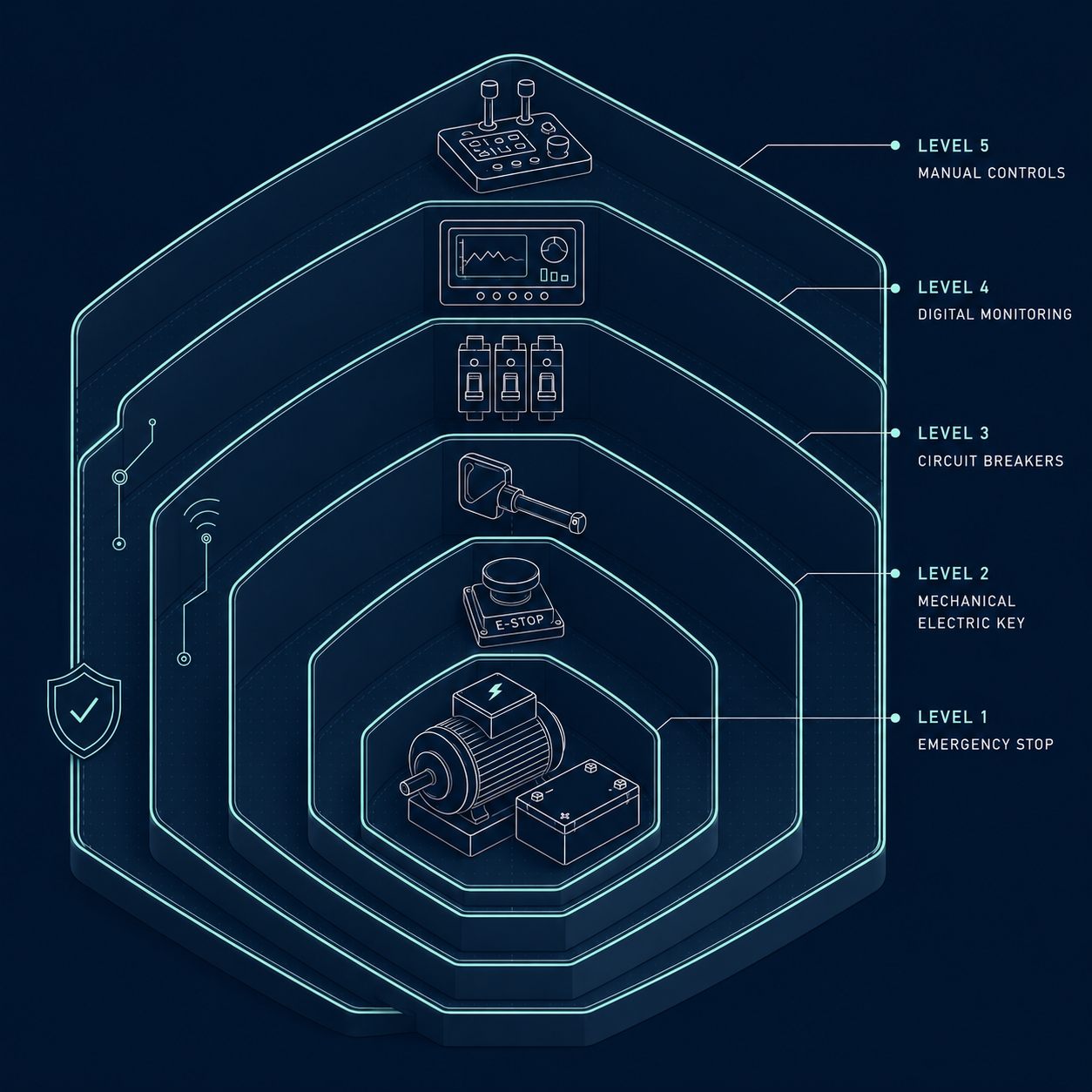
Safety hierarchy
Five concentric levels of protection with graceful degradation — from a master cut-off to a full analogue fallback. The proof that "manual control + graceful degradation" is engineering, not marketing.
Already validated, not invented
Every shipyard already lives with 230V onboard. Some manage it better than others — but the integration is bespoke per model, expensive to engineer and still built on legacy 24V logic. WOMBAT systematises what's already there with a cleaner architecture that runs cooler and more efficiently, and adds the VEM (Vessel Energy Manager) orchestration layer none of them have yet. We're not asking you to bet on an unproven idea; we're industrialising one you already trust.
Standards & compliance
WOMBAT is engineered to recognised marine-grade safety and electrical standards, and designed from day one for straightforward CE marking and homologation. We prepare the technical documentation and work alongside accredited notified bodies and classification societies — so compliance is built into the design, not bolted on, and the burden stays off your team.
Next step
See how it changes the build, the owner experience and the business case — or talk it through with our engineers.